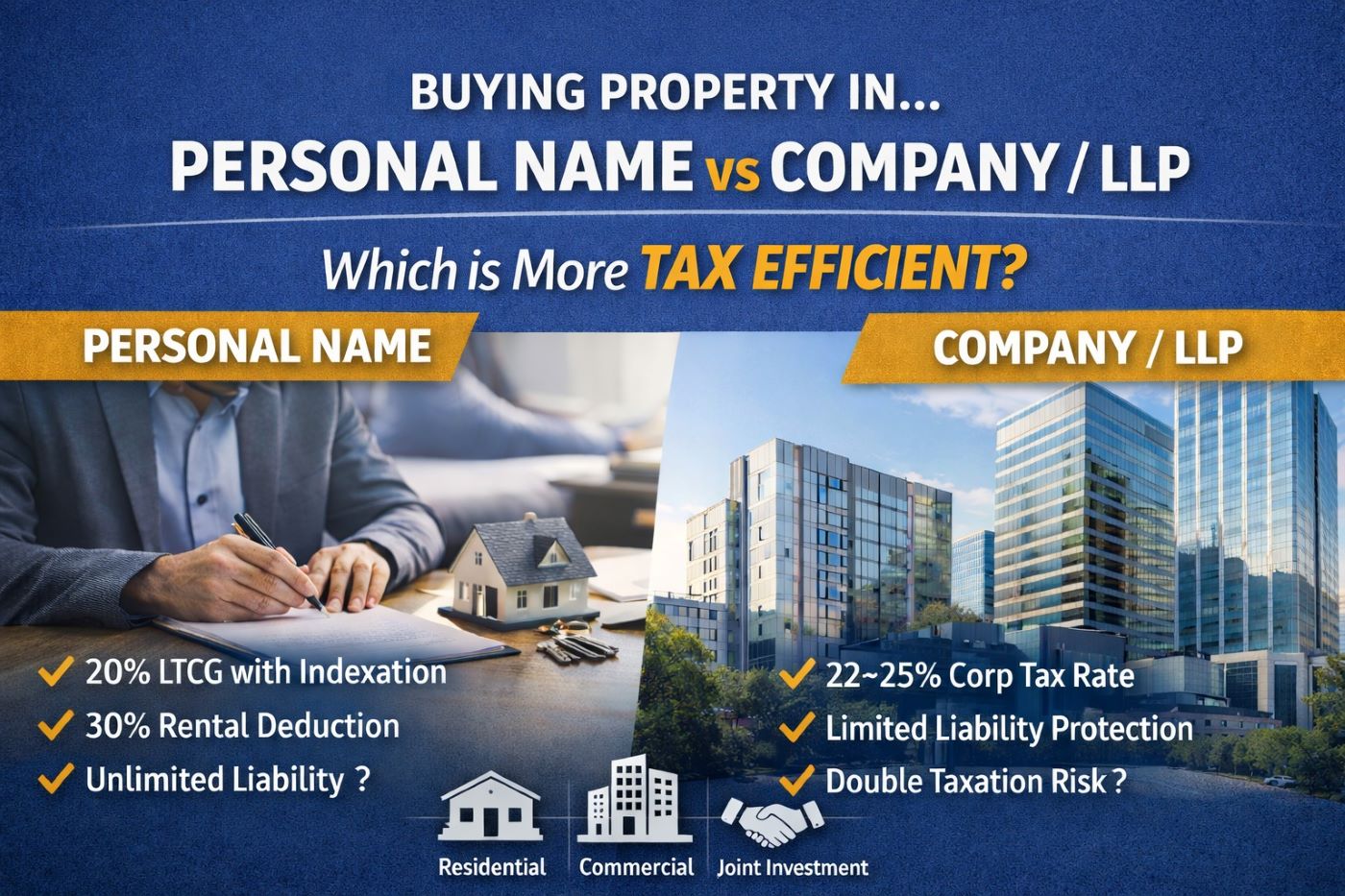
Choosing the right ownership structure while investing in real estate is not just a legal formality — it directly impacts your rental income taxation, capital gains liability, asset protection, succession planning, and overall ROI.
Whether you are a retail investor, HNI, NRI, or building a commercial portfolio, understanding the tax difference between:
- Buying in personal name
- Buying through a Private Limited Company
- Buying through an LLP
can significantly improve long-term returns.
Let’s break it down in detail.
1.Buying Property in Personal Name
For most individual investors in India, this is the simplest structure.
Tax on Rental Income
Rental income is taxed under Income from House Property:
- 30% standard deduction (Section 24)
- Interest on home loan deductible (subject to limits for self-occupied)
- Property tax deduction allowed
This structure is often beneficial for salaried investors who want passive rental income.
Capital Gains Tax
- Short Term Capital Gain (≤ 24 months) → Taxed as per slab rate
- Long Term Capital Gain (> 24 months) → 20% with indexation
Exemptions available under:
- Section 54 (Reinvestment in residential property)
- Section 54EC (Investment in specified bonds)
Advantages
- Simple compliance
- Lower maintenance cost
- Indexation benefit available
- Easier loan eligibility
Limitations
- Unlimited personal liability
- High slab rate (30%) for high-income individuals
- Limited business expense deductions
2.Buying Property Through a Private Limited Company
This structure is typically used for large portfolios, commercial leasing, or structured real estate businesses.
Tax on Rental Income
Rental income is usually treated as Business Income.
Corporate tax rates:
- 22% (new regime without exemptions)
- 25% (older regime depending on turnover)
Deductions Available
- Full business expenses
- Depreciation on building (if applicable)
- Full interest deduction
- Maintenance & operational cost deduction
Capital Gains Tax
- Taxed at corporate rates
- Indexation benefit generally not available in the same manner as individuals
Major Consideration: Double Taxation
If profits are distributed as dividends, shareholders pay additional tax. This can reduce overall efficiency.
Advantages
- Limited liability
- Suitable for large commercial portfolios
- Easier succession via share transfer
- Better structured investor entry/exit
3. Buying Property Through LLP (Limited Liability Partnership)
LLP is a hybrid structure combining partnership flexibility with limited liability.
Tax Structure
- Flat tax rate: 30%
- No dividend distribution tax
- Interest & remuneration to partners allowed
- Business expenses deductible
Advantages
- Limited liability
- No double taxation like companies
- Flexible profit sharing
- Moderate compliance requirements
Limitations
- Higher base tax rate (30%)
- Not ideal for purely passive rental strategy
- Limited fundraising flexibility
Which Structure Is More Tax-Efficient?
Choose Personal Name If:
- You invest in residential property
- Long-term capital gains planning is priority
- You want indexation benefit
- You are in lower or mid tax slab
Choose Company If:
- You are building a large commercial portfolio
- Rental income is substantial
- You want structured exits
- You want better asset protection
Choose LLP If:
- 2–3 investors are pooling capital
- You want flexibility without dividend taxation
- You operate active real estate business
Strategic Tax Planning Insight (Important for Serious Investors)
The most tax-efficient structure depends on:
- Nature of property (Residential vs Commercial)
- Number of properties
- Rental income volume
- Exit strategy
- Succession planning
- Cross-border taxation (especially for NRIs)
For many investors:
- Residential → Personal name
- Commercial leasing → Company
- Joint investments → LLP
However, advanced investors often combine structures for optimal tax planning and risk management.
Conclusion
There is no one-size-fits-all answer. The right ownership structure can significantly improve post-tax returns, reduce liability risk, and simplify long-term wealth transfer.
Before making a decision, evaluate:
- Your income slab
- Investment horizon
- Capital gains strategy
- Compliance comfort
- Asset protection needs
Strategic structuring at the time of purchase can save lakhs in taxes over the long term.