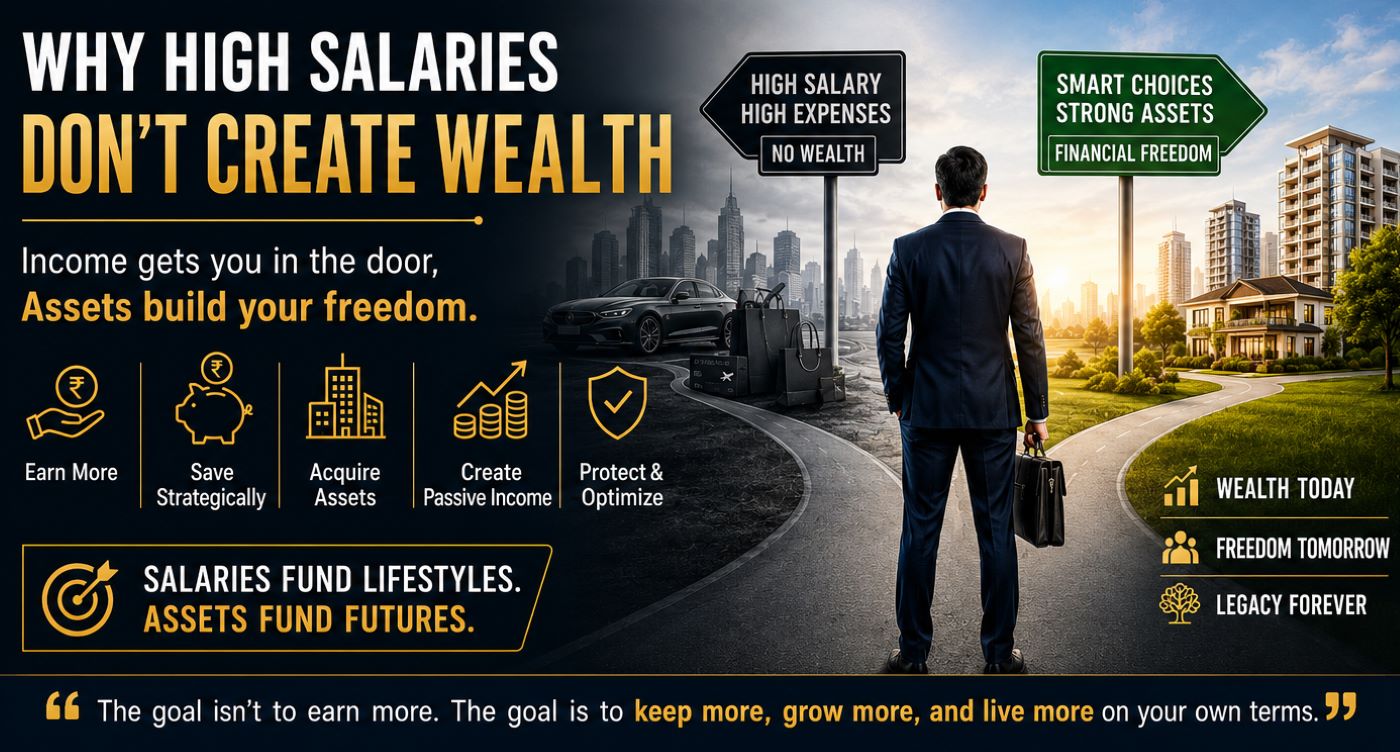
Why High Salaries Don't Create Wealth
Most people believe:
"If I can earn a bigger salary, I'll become wealthy."
Unfortunately, reality tells a different story.
Many professionals earn:
? ?25 lakh annually
? ?50 lakh annually
? ?1 crore+ annually
Yet remain financially dependent on their next paycheck.
At the same time, others with lower incomes build substantial wealth and achieve financial freedom.
The difference?
Income creates cash flow. Assets create wealth.
Salary is Income, Not Wealth
A salary is temporary.
Wealth is permanent.
Your salary depends on:
? Your job? Your performance? Your employer? Economic conditions
Wealth depends on:
? Assets? Investments? Businesses? Passive income
Important Distinction
The day your salary stops, income stops.
The day your assets continue producing income, wealth begins.
The Lifestyle Inflation Trap
One of the biggest reasons high earners fail to build wealth is lifestyle inflation.
As income rises:
• House gets bigger
• Car gets bigger
• Expenses get bigger
• Expectations get bigger
But investments often stay the same.
Example
Salary increase = ?5 lakh
Many people spend:
?4 lakh on lifestyle
?1 lakh on investments
Successful wealth builders often do the opposite.
High Income Can Create a False Sense of Security
A professional earning ?75 lakh annually may appear financially secure.
However:
? No passive income? No investment strategy? No asset accumulation? High liabilities
If employment ends unexpectedly, financial stress begins quickly.
High income does not eliminate financial risk.
Asset ownership does.
Wealthy People Buy Assets First
The wealthy focus on acquiring:
? Real estate? Businesses? Dividend-paying investments? REITs? Income-generating assets
Average earners often focus on:
? Cars? Luxury purchases? Lifestyle upgrades? Status symbols
Wealth Principle
Assets pay for luxuries.
Salaries should not.
Wealth is Built Through Ownership
Look at many of the world's wealthy individuals.
They don't simply earn income.
They own:
? Companies? Real estate? Intellectual property? Investments
Ownership creates leverage.
Ownership creates scalability.
Ownership creates wealth.
Real Estate and Wealth Creation
Real estate remains one of the most popular wealth-building tools because it offers:
Appreciation
Property values may grow over time.
Rental Income
Cash flow while you hold the asset.
Leverage
Control a larger asset with a smaller initial investment.
Wealth Preservation
Physical assets often provide long-term stability.
The Multiple Income Stream Strategy
Successful investors aim to create:
Income Stream 1
Salary
Income Stream 2
Rental income
Income Stream 3
Dividend income
Income Stream 4
Business ownership
Income Stream 5
Global investments
The goal is not to replace income immediately.
The goal is to reduce dependence on a single source.
The Wealth Formula
Step 1
Earn income.
Step 2
Convert income into assets.
Step 3
Allow assets to generate income.
Step 4
Reinvest the income.
Step 5
Repeat consistently.
This is how wealth compounds.
Salary vs Wealth
Salary Wealth
Active Income Passive Income
Depends on Work Depends on Assets
Temporary Long-Term
Taxed Immediately Can Be Structured Efficiently
Stops When You Stop Continues Working
Common Mistakes High Earners Make
? Upgrading lifestyle too quickly
? Delaying investments
? Relying on one income source
? Ignoring passive income
? Focusing on appearances instead of net worth
? Buying liabilities instead of assets
What Wealthy Professionals Do Differently
Successful professionals:
? Invest early? Buy income-producing assets? Focus on net worth? Create multiple income streams? Think long-term? Build passive income
They understand:
High income creates opportunity.
Asset ownership creates freedom.
???? Final Verdict
A high salary is a powerful tool.
But it is only the starting point.
Financial freedom is achieved when income is converted into assets that continue producing income long after the work has been done.
The goal is not to earn more forever.
The goal is to own more.
Because:
Wealth is not measured by how much you earn.
Wealth is measured by how long your assets can support your lifestyle.